
In cooling tower systems, water continuously circulates to carry heat away from equipment and release it into the air. While the process may seem straightforward, improper flow control or backflow can reduce cooling efficiency and even cause operational stress on pumps and the overall system.
In real-world projects, system stability often depends on how well the valves are configured. Butterfly valves are used for flow regulation, while check valves prevent reverse flow and protect equipment—making them two of the most critical valve types in cooling tower systems. This article will explain their typical installation locations and key selection considerations based on how the system operates.
Cooling Tower System Overview
Cooling tower systems operate on a recirculating water loop. Warm water leaves the equipment or heat exchangers and is pumped to the cooling tower, where it comes into full contact with air through the fill. Heat is dissipated through evaporation and heat exchange, after which the cooled water returns to the system for continuous reuse.
Throughout this process, the piping network connects the pumps, cooling tower, and various pieces of equipment, forming the backbone of stable system operation. Valves are installed at key points to control flow, isolate equipment, and ensure safe and reliable performance.
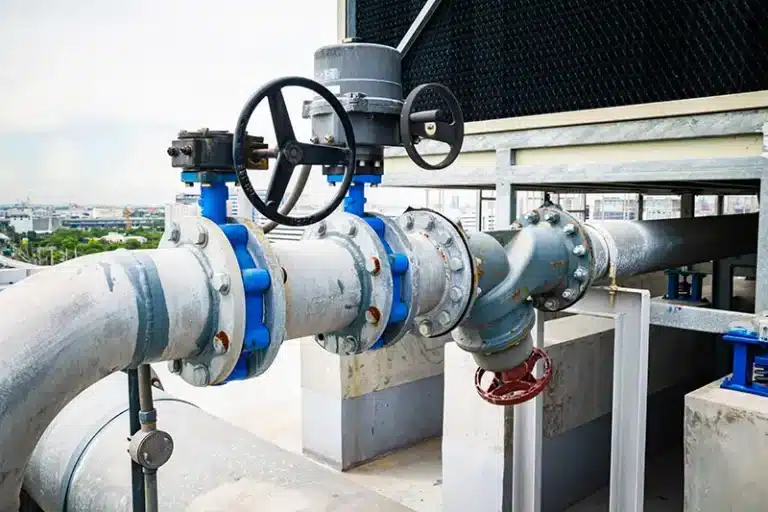
What Valves Are Used in Cooling Tower Systems
1. Butterfly Valves in Cooling Tower Systems
Butterfly valves are the most commonly used type in cooling water systems, primarily applied for flow control in large-diameter pipelines.
They feature a compact structure, light weight, and minimal space requirements, and can be operated manually, electrically, or pneumatically to suit different levels of automation. In high-flow circulation systems, butterfly valves are often the most practical and cost-effective choice.

2. Gate Valves(Isolation Use)
Gate valves are mainly used for system isolation and are typically installed on main pipelines or upstream and downstream of equipment.
Their advantage lies in low flow resistance when fully open and reliable sealing performance. However, they are not suitable for frequent operation or flow regulation, so they are generally used as auxiliary valves within the system.

3. Check Valves in Cooling Systems
Check valves are designed to prevent backflow and are usually installed at the pump outlet.
They automatically close when the pump stops, preventing reverse flow from impacting the pump and helping to reduce water hammer, making them an essential component for ensuring safe system operation.

Where Are Valves Installed in a Cooling Tower System?
In a typical cooling tower system, valves are installed at several key points to control water flow and maintain stable operation.
- Cooling Tower Inlet & Outlet
Butterfly valves are used to regulate the water flow entering and leaving the cooling tower, and can also serve as isolation valves during maintenance.
- Main Circulation Pipeline
Butterfly valves are applied for overall flow control and for balancing flow distribution across multiple branches.
- Pump Discharge
Check valves are installed at the pump outlet to prevent backflow. This is the most critical location for system protection.
- Before & After Equipment (Optional)
Gate valves or butterfly valves may also be installed upstream and downstream of heat exchangers or other key equipment. These valves allow for isolation during maintenance, making system servicing more convenient.
Why Butterfly Valves Are Widely Used
Cooling tower systems typically operate under high flow rates with continuous circulation. The pipelines are often large in diameter, and the equipment layout is relatively concentrated.
Under these conditions, butterfly valves have become the preferred choice for large-diameter pipelines thanks to their compact design, light weight, ease of installation, and cost efficiency.
Why Check Valves Are Essential in Cooling Systems
Cooling tower systems rely on pumps to maintain continuous circulation. When a pump stops, the flow conditions within the pipeline change—especially in systems with elevation differences or long piping runs—making backflow and pressure fluctuations more likely.
Check valves automatically close when the pump shuts down, preventing reverse flow and helping stabilize the system. This reduces the impact on pumps and piping, which is particularly important for systems operating continuously over long periods.
Key Considerations for Valve Selection
- Pipe Size
The main circulation pipelines in cooling tower systems are typically large in diameter. Valves should be selected accordingly, with butterfly valves being the preferred choice for large-size applications.
- Installation Space
Cooling towers are often installed on rooftops or equipment floors where space is limited. Butterfly valves are well suited for such compact environments due to their space-saving design.
- Operation Method
The operation method should match the level of system automation. Manual operation is suitable for simple systems, while electric or pneumatic actuators are better suited for automated control.
- Medium & Environment
- Valve Body: Ductile iron is commonly used under standard conditions
- Disc: Stainless steel or corrosion-resistant coated materials can be selected
- Seat: EPDM is a common choice for cooling water systems
- Stem: Stainless steel is recommended to reduce the risk of corrosion and sticking
- System Protection Requirements
A check valve is typically installed at the pump discharge to prevent backflow when the pump stops and to minimize impact on the pump and pipeline. Depending on operating conditions, different types can be selected:
- Wafer Check Valve: Compact design, ideal for space-limited installations
- Silent Check Valve: Smoother closing action, helping to reduce water hammer effects

- Maintenance
Ease of maintenance should also be considered during valve selection.
- Butterfly Valves: Simple structure, easy to install and remove, with seals that are relatively easy to replace
- Check Valves: Prefer designs that allow easy inspection and cleaning to simplify long-term maintenance
- Pressure & Shut-Off Differential
It is important to consider the actual differential pressure and ensure it matches the actuator capacity, avoiding issues such as incomplete shut-off or actuator overload.

FAQ
Butterfly valves, check valves, and gate valves are commonly used.
At pump discharge to prevent backflow.
They are compact, cost-effective, and ideal for large pipelines.
Conclusion
Butterfly valves and check valves are the two most critical valve types in cooling tower systems, responsible for flow control and system protection respectively. Proper valve configuration not only improves overall system stability but also helps reduce long-term maintenance costs.
TFW Valve offers reliable butterfly valve and check valve solutions for HVAC and cooling water systems. If you have a specific project requirement, feel free to contact us for selection support and a prompt quotation.




