
Wastewater treatment systems are more demanding than many clean water pipelines. The media can contain suspended solids, sand, fibers, grease, chemicals, biological sludge, and other impurities. Because of this, valve selection must be more practical and more cautious. A valve that works well in a clean water line may not provide the same service life in a wastewater plant.
In many wastewater treatment projects, butterfly valves are widely used because they are compact, easy to operate, and cost-effective for medium and large diameter pipelines. They are especially common in aeration systems, treated water lines, return water lines, pump station isolation, and general process water control.
However, butterfly valves are not suitable for every wastewater application. In lines with heavy sludge, large particles, rags, or fibrous media, other valve types such as knife gate valves may be more appropriate. The key is to understand where butterfly valves perform well, where they should be avoided, and how to select the correct material and sealing structure for each part of the plant.

Why Valve Selection Is Different in Wastewater Treatment
Compared with municipal clean water systems, wastewater treatment plants have more complex operating conditions. The flow is not always stable, the media composition can change, and some pipelines may carry solids or biological materials. This means the valve must be selected according to the actual location in the treatment process.
For example, influent lines and sludge lines may contain large particles, grit, fibers, and organic matter. These materials can easily get trapped around a sealing surface. If a soft-seated butterfly valve is installed in the wrong position, the seat may wear quickly or the disc may not close completely.
On the other hand, many areas of a wastewater treatment plant are much cleaner. After screening, sedimentation, filtration, or biological treatment, the water may contain fewer large particles. In these sections, butterfly valves can provide reliable isolation and flow control with a relatively simple structure and lower cost.
This is why there is no single answer to the question “Can butterfly valves be used in wastewater?” The more accurate answer is: yes, but only when the media condition, solids content, valve material, and installation position are suitable.
Where Butterfly Valves Are Commonly Used in Wastewater Plants
In real wastewater treatment projects, butterfly valves are usually selected for sections where the flow is relatively large and the media is not extremely heavy with solids. The following applications are common.
Treated Water and Effluent Lines
After wastewater has passed through screening, sedimentation, biological treatment, filtration, or disinfection, the water quality becomes much more stable than raw influent. Butterfly valves are commonly used in treated water pipelines, effluent discharge lines, and reclaimed water systems.
In these locations, the main requirements are reliable shutoff, corrosion resistance, low operating torque, and long service life. Ductile iron body valves with epoxy coating and EPDM seats are often used when the media is mainly water with limited suspended solids.
Aeration and Air Lines
Wastewater treatment plants often use aeration systems in biological treatment tanks. Butterfly valves may be used on air pipelines to isolate sections or adjust airflow. In this application, the media is air rather than liquid wastewater, but moisture, temperature, and chemical environment should still be considered.
For air lines, the valve should open and close smoothly, and the operator or actuator should be selected based on the pipe diameter and control requirements. If airflow adjustment is frequent, the valve should be checked for disc position control and long-term wear.
Pump Station Isolation
Butterfly valves can be installed on pump suction or discharge lines for isolation. They are often used together with check valves to prevent backflow and protect pumps. In pump stations, valve closing speed is important because sudden flow changes can cause pressure surges and water hammer.
For more information about pressure shock in water systems, you can also read How to Prevent Water Hammer in Cooling Systems. Although that article focuses on cooling systems, the basic principle of rapid flow change also applies to many pumping applications in wastewater plants.
Process Water and Utility Water Lines
Wastewater plants use utility water for cleaning, flushing, chemical preparation, and other support operations. These pipelines often have lower solids content than raw sewage lines. Butterfly valves are a practical choice for many of these systems because they are simple, compact, and easy to maintain.

Where Butterfly Valves Should Be Selected Carefully
Butterfly valves can be useful in wastewater plants, but they should not be installed everywhere without checking the media. Some wastewater lines create conditions that are difficult for a standard soft-seated butterfly valve.
Raw Sewage Lines
Raw sewage can contain rags, plastic, fibers, sand, and other debris. If these materials are caught between the disc and the seat, the valve may not close tightly. Over time, repeated contact with hard particles can scratch the disc edge or damage the rubber seat.
If a butterfly valve is used in a raw sewage line, the engineer should confirm the screening condition, particle size, flow velocity, and maintenance access. In many cases, a knife gate valve may be more suitable because it is designed to cut through or handle media with solids and fibers more effectively.
Sludge Lines
Sludge pipelines are one of the most challenging areas in wastewater treatment. Sludge can be thick, sticky, and uneven. It may also contain fibers and particles that accumulate around the valve body. A standard concentric butterfly valve may experience high torque, incomplete closure, and sealing problems in these conditions.
For thick sludge, a knife gate valve is often considered because its gate can pass through the media more directly. TFW has also compared this topic in How to Choose Between Knife and Wedge Gate Valves, where the difference between clean water shutoff and solids-handling applications is discussed.
Lines with Grit or Sand
Grit and sand can shorten the service life of soft seats. When abrasive particles pass through the valve, they may wear the seat, disc edge, and sealing surface. If the pipeline contains abrasive media, material selection becomes more important. In some cases, the system should include proper screening, settling, or flushing before the valve location.
Choosing the Right Butterfly Valve Type
The valve connection type should be selected according to pipeline size, pressure, installation space, and maintenance requirements. Common butterfly valve designs include wafer, lug, U-type, and double flanged structures.
Wafer Butterfly Valves
Wafer butterfly valves are compact and economical. They are installed between two flanges using long bolts. This design is common in process water, utility water, and many general isolation applications.
For wastewater plants, wafer valves can be a good choice when the pipeline is accessible and the media is not heavy sludge. However, if the valve is installed in a place where one side of the pipeline may need to be removed during maintenance, other connection types may be better.
Lug Butterfly Valves
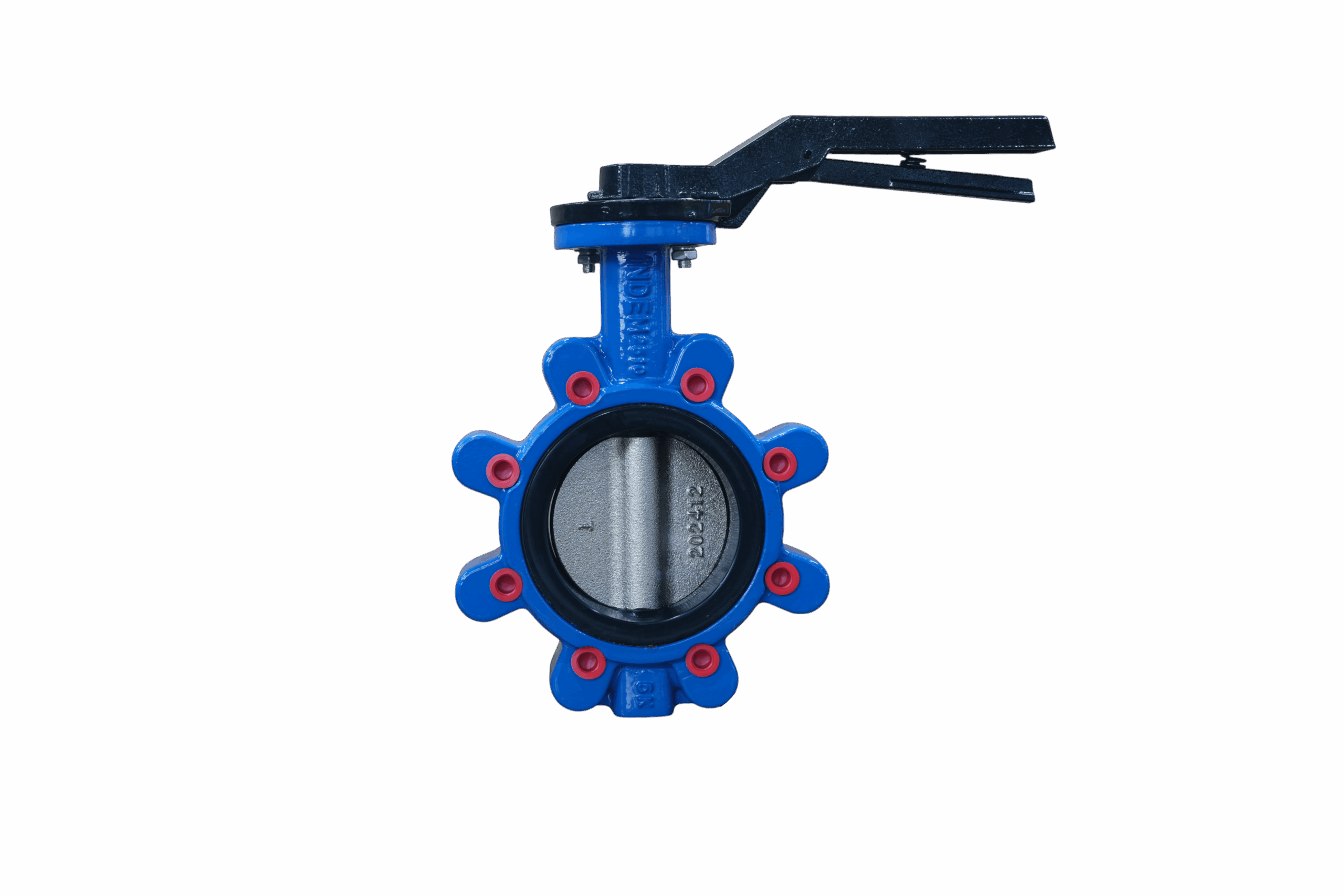
Lug butterfly valves have threaded lugs around the body. They provide more installation flexibility and may be useful in maintenance sections. In wastewater plants, lug valves are often considered when isolation and service access are important.
Double Flanged Butterfly Valves
Double flanged butterfly valves are often selected for larger diameter pipelines, pump station discharge lines, and more robust installations. The flanged body provides strong connection support and is easier to align in some large pipeline systems.
Material Selection for Wastewater Applications
Material selection is one of the most important parts of wastewater valve design. The valve must resist corrosion, abrasion, and long-term exposure to changing water quality.
Body Material
Ductile iron is commonly used for wastewater treatment valves because it offers good strength and cost performance. Compared with cast iron, ductile iron has better toughness and is more suitable for pressure-bearing systems. For wastewater service, protective coating is very important. Epoxy coating is often used to help protect the body from corrosion.
For more corrosive environments, carbon steel, stainless steel, or special alloy options may be considered. The choice depends on chemicals, chloride content, pH, temperature, and project budget.
Disc Material
The disc is directly exposed to the media. Common disc materials include ductile iron with coating, stainless steel 304, stainless steel 316, and aluminum bronze. In normal wastewater treatment plant water lines, a coated ductile iron disc may be sufficient. In more corrosive water or coastal applications, stainless steel 316 or aluminum bronze may provide better long-term resistance.
Seat Material
EPDM is commonly selected for water and wastewater applications because it performs well in water service and has good aging resistance. NBR is more suitable when oil resistance is needed. PTFE has strong chemical resistance, but it is less elastic than rubber and may not be the first choice for general wastewater isolation.
Incorrect seat material can cause swelling, hardening, cracking, or leakage. TFW has explained sealing behavior in more detail in How Do Butterfly Valves Seal? Types and Solutions.
Soft-Seated or Metal-Seated Butterfly Valves?
Most wastewater treatment plant water lines use soft-seated butterfly valves. The elastic seat helps create a tight seal and keeps operation relatively simple. For clean or treated water sections, soft-seated valves are usually practical and economical.
Metal-seated or eccentric butterfly valves may be considered when temperature, pressure, or media conditions are more demanding. However, they are usually more expensive and may not be necessary for ordinary wastewater plant utility lines. The selection should be based on actual operating conditions rather than simply choosing the strongest structure.
For buyers comparing different butterfly valve prices, it is important to confirm whether the quotation is for a soft-seated concentric valve, double eccentric valve, triple eccentric valve, or metal-seated design. These differences can significantly affect cost. You can read more in What Affects Butterfly Valve Price?.
Installation Points That Affect Service Life
Many valve problems in wastewater treatment plants are not caused by the valve itself. They are caused by unsuitable installation, poor pipeline support, debris in the system, or lack of maintenance.
Confirm Flange Standard and Gasket Position
Before installation, the flange standard must match the valve body. Common standards include EN, DIN, ANSI, JIS, and AS. If the flange drilling or gasket position is incorrect, the valve may leak or the disc may not move freely.
Leave Enough Disc Clearance
The butterfly valve disc rotates inside the pipeline. If the pipe inner diameter, lining, gasket, or flange shape interferes with the disc, the valve may not fully open. This can increase pressure loss and damage the sealing area.
Flush the Pipeline Before Operation
Wastewater projects often involve construction debris, welding slag, sand, and other particles before commissioning. These materials can damage the seat when the valve is operated for the first time. Flushing the pipeline before final operation is a simple step that can prevent many early failures.

Common Problems in Wastewater Butterfly Valves
Internal Leakage
Internal leakage occurs when media continues to pass through the valve after it is closed. In wastewater applications, this can be caused by solids trapped at the seat, seat wear, disc damage, or incomplete closing. If the valve is used in a line with particles, regular inspection is important.
High Operating Torque
High torque can occur when debris accumulates around the disc, when the seat deforms, or when the valve has not been operated for a long period. Large diameter valves should use proper gear operators or actuators. Operators should not force the valve without checking the cause, because this may damage the stem or gearbox.
External Leakage
External leakage may appear at the flange, stem area, or body connection. Common causes include loose bolts, damaged gaskets, pipe misalignment, or long-term corrosion. In wastewater plants, regular visual inspection helps identify small problems before they become serious.
Procurement Checklist for Wastewater Treatment Projects
When requesting a quotation, it is helpful to provide complete operating information. This allows the manufacturer to recommend a suitable configuration instead of only quoting by size.
- Nominal diameter and pressure rating
- Connection type: wafer, lug, U-type, or double flanged
- Media condition: treated water, raw sewage, sludge, process water, or air
- Solids content, particle size, and whether fibers or rags are present
- Working pressure, test pressure, and temperature
- Required flange standard
- Body, disc, stem, and seat material requirements
- Manual, gear, electric, pneumatic, or hydraulic operation
- Coating requirements and corrosion environment
- Testing, certification, and inspection requirements
Providing these details reduces the risk of receiving a valve that looks correct by size but is unsuitable for the actual wastewater condition.
When to Choose Knife Gate Valves Instead
In wastewater treatment, butterfly valves and knife gate valves are often used in different positions. Butterfly valves are suitable for many water, treated water, air, and general isolation lines. Knife gate valves are more suitable for sludge, slurry, fibers, and media with more solids.
If the pipeline contains thick sludge, paper-like fibers, or materials that may block a disc, a knife gate valve may reduce the risk of jamming. For cleaner water sections, a butterfly valve may provide easier operation and better cost performance.
The best selection is not based on the valve name alone. It depends on the media, solids content, pressure, installation access, and maintenance plan.
Conclusion
Butterfly valves are widely used in wastewater treatment systems, especially in treated water lines, process water systems, aeration pipelines, pump station isolation, and general plant utility lines. Their compact structure, quick operation, and good cost performance make them practical for many medium and large diameter pipelines.
At the same time, wastewater applications require careful selection. Raw sewage, sludge, grit, and fibrous media can create sealing problems for standard soft-seated butterfly valves. Before selecting a valve, engineers and buyers should review the media condition, solids content, pressure rating, connection type, material, seat design, and maintenance access.
TFW Valve can provide different butterfly valve configurations for water and wastewater applications, including wafer, lug, double flanged, soft-seated, and eccentric butterfly valves. If you are selecting valves for a wastewater treatment plant, pump station, or process water pipeline, you can review our butterfly valve products or contact us with your project specifications.




