
Municipal pipeline networks are a core component of urban water supply and drainage systems, and their safety, stability, and economic efficiency are critical to the reliable operation of a city. As key devices for controlling flow and isolation, flange butterfly valves are widely used in municipal pipeline networks, and valve selection has a direct impact on overall system reliability as well as long-term operating costs.
Among the many valve types available, double-flanged butterfly valves have become a preferred choice for municipal water and wastewater projects due to their balanced overall performance. This article examines why they are so widely adopted in municipal engineering, focusing on their structure, connection method, performance characteristics, cost considerations, and typical application scenarios.
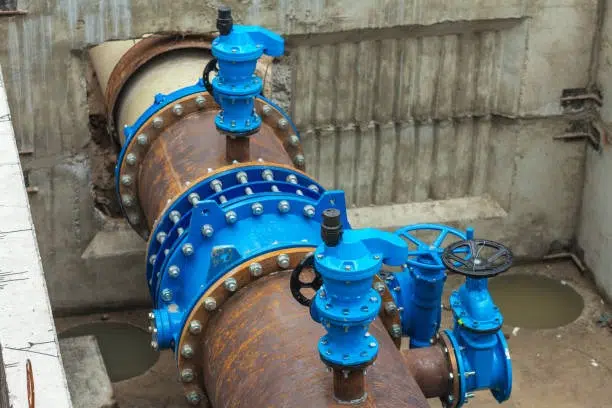
Inherent Advantages of Butterfly Valves
(Compared with Gate Valves and Ball Valves)
Compact structure:
Compared with gate valves of the same nominal diameter, butterfly valves are significantly thinner in face-to-face dimension. This becomes a decisive advantage in municipal pipe galleries or valve chambers where installation space is limited.
Fast operation and low operating torque:
A 90-degree rotation is sufficient to achieve full opening or full closure. The required operating torque is relatively low, allowing the valve to be easily equipped with manual, electric, or hydraulic actuators, and making remote or automated control straightforward to implement.
Cost efficiency:
Especially in large-diameter pipelines (DN300 and above), butterfly valves are far more economical than gate valves or ball valves of the same size. For large-scale municipal projects that require a substantial number of valves, this results in significant capital cost savings.
Connection Advantages of Double-Flanged Butterfly Valves
Connection method: The valve is equipped with integral flanges on both ends, which are bolted directly to the mating flanges on the pipeline using bolts and nuts.
Advantages of Flanged Connections
1.Standardization and versatility: Flanged connections are among the most standardized and widely used connection methods in industrial piping. Municipal systems commonly use steel pipes, ductile iron pipes, and concrete pipes with flanged ends, allowing double-flanged butterfly valves to integrate seamlessly into existing pipeline networks with excellent compatibility.
2.Robust and reliable connection: The full-circumference bolting between the valve flanges and the pipeline flanges provides high connection rigidity and uniform load distribution. This enables the valve to withstand water hammer effects and pressure fluctuations effectively.
3.Ease of installation and removal: When a valve needs replacement or repair, it can be removed simply by loosening the bolts, without cutting the pipeline or performing complex welding operations. This greatly reduces shutdown time, shortens maintenance windows, and lowers construction difficulty and risk.

Performance Advantages of Double-Flanged Butterfly Valves
1.Reliable sealing performance:
Double-flanged butterfly valves can be used with gaskets made from different materials—such as rubber, PTFE, or metal—to suit various media. Municipal pipelines typically operate continuously for long periods, and the strong sealing capability of flanged butterfly valves helps prevent leakage and contamination, making them particularly suitable for potable water and wastewater networks.
2.High pressure-bearing capacity:
Well suited for large-diameter pipelines (DN300 and above), double-flanged butterfly valves can evenly withstand transient pressure fluctuations caused by water hammer and pump start-up or shutdown, ensuring safe operation under high pressure and variable flow conditions.
3.High tolerance to media conditions:
Media in municipal water supply, wastewater, and stormwater systems are not perfectly clean and may contain small amounts of suspended solids or impurities. With a relatively simple disc design and a near-straight flow path when open, double-flanged butterfly valves offer better tolerance to solid particles than gate valves or ball valves, reducing the risk of blockage.
4.Flow regulation capability:
Although butterfly valves are primarily designed for isolation and on/off service, they can provide flow regulation at partial openings. This makes them suitable for applications such as zone pressure control or flow distribution. However, prolonged operation at partially open positions should be avoided to prevent accelerated wear of the valve seat.
Comparison of Flanged vs Lug Butterfly Valves
Connection Advantages
Lug Butterfly Valves: Lug-type valves don’t have full flanges; they are clamped between the pipeline flanges using lug bolts. This design allows for easy single-end removal, but their pressure-bearing capacity is slightly lower.
Flanged Butterfly Valves: These valves are secured to the pipeline flanges with bolts all around, allowing the valve body and pipeline connection surfaces to evenly bear the pressure. This makes double-flanged butterfly valves especially advantageous in large-diameter, high-pressure, or long-distance pipeline networks.
Standardization and Compatibility
Municipal projects typically follow unified standards (e.g., EN, DIN, ANSI flange standards). Flanged butterfly valves match these flange standards, making procurement and installation more straightforward.
Lug butterfly valves may have variations in bolt sizes across manufacturers, resulting in slightly weaker compatibility.
Cost Advantages of Double-Flanged Butterfly Valves
Lower Initial Investment: Butterfly valves are significantly cheaper than gate valves or ball valves of the same size. For large municipal projects requiring many valves, the cost advantage of large-diameter butterfly valves is clear.
Lower Operating Costs: When fully open, the valve disc is nearly parallel to the flow, creating minimal flow resistance and reducing head loss along the pipeline. This can lead to significant energy savings in pumping stations.
Lower Maintenance Costs: With a simple structure and few failure points, butterfly valves are easy to maintain. The main wear component is the sealing seat, which can usually be replaced without removing the valve, minimizing downtime and maintenance expenses.

Application Scenarios in Municipal Pipelines
Double flanged butterfly valves are utilized across nearly all critical points in municipal pipeline networks:
- Water Source Intake and Plant Outlets: Where reliable shut-off is essential.
- Junctions Between Main Lines and Branch Pipelines: For regional flow distribution and isolation.
- Valve Groups and Valve Chambers: Serving as primary valves for maintenance and control.
- Pump Station Inlets and Outlets: To protect equipment and isolate systems.
- Inlet and Outlet Pipes of Reservoirs: Functioning as control valves.
In summary, the design of double flanged butterfly valves successfully balances reliability, functionality, economy, and maintainability. This makes them an ideal fit for the long-term stable operation and convenient maintenance demands of municipal pipeline systems, solidifying their position as the preferred solution in municipal projects.
With deep expertise in municipal pipeline operating conditions, TFW Valve’s double flanged butterfly valves are engineered to meet the high standards of municipal engineering in design, material selection, sealing technology, and connection methods. Whether applied in large-diameter water supply networks, wastewater discharge systems, or pump stations, TFW Valve’s double flanged butterfly valves contribute to the long-term reliability and cost-efficiency of municipal pipeline infrastructure.
If you have any further questions, please feel free to contact us.




