In water supply networks, water treatment plants, HVAC systems, and other fluid-handling projects, engineers and procurement teams often ask: “Can a butterfly valve be used for flow control?” The answer isn’t a simple yes or no. A sound decision depends on understanding the valve’s characteristics and the specific operating conditions.
This article takes a clear, technical look at where butterfly valves perform well—and where they are limited—in throttling service. Our goal is to help you weigh the trade-offs and select the most economical and reliable solution for your project.
How Does a Butterfly Valve Work in Flow Control
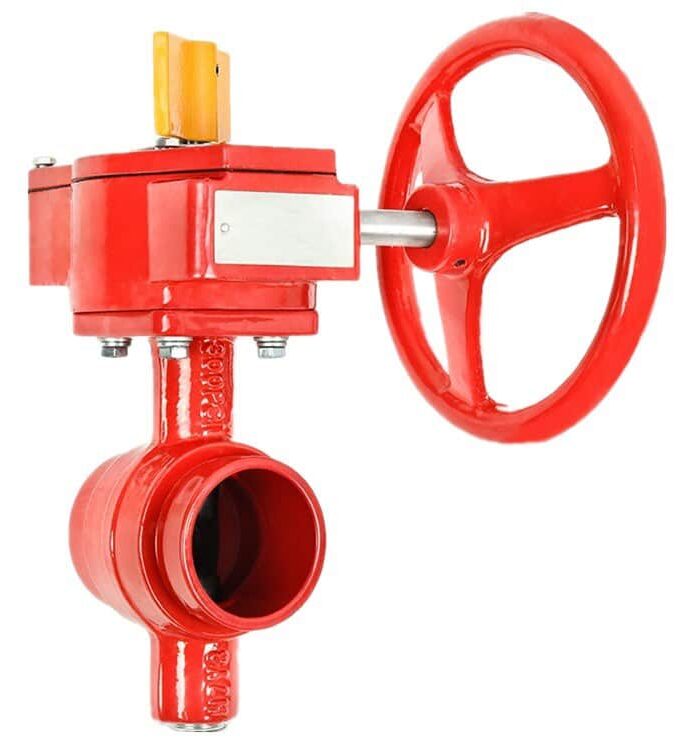
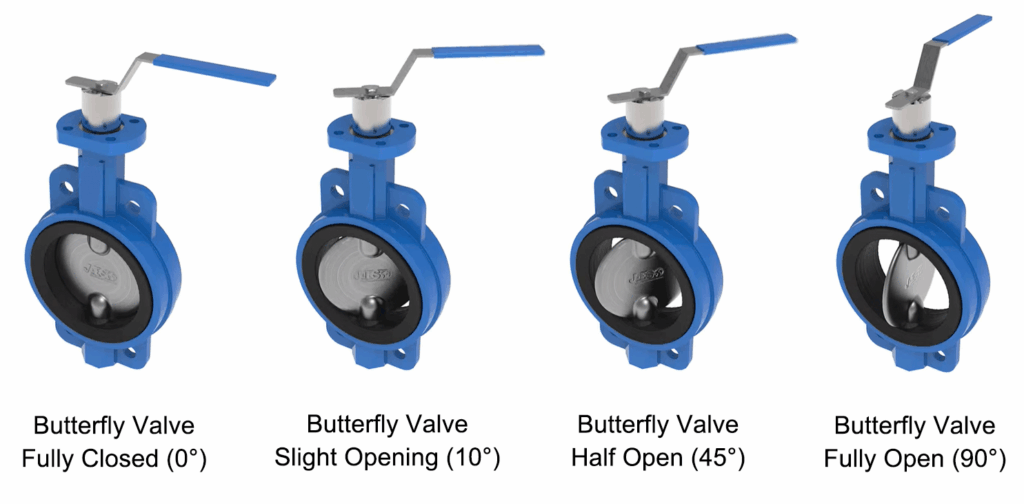
The core structure of a butterfly valve consists of the valve body, a disc-shaped plate, and the stem. Its operating principle is much like the motion of butterfly wings: by rotating the stem, the disc turns within a range of 0° (fully closed) to 90° (fully open). This rotation changes the flow passage area, thereby controlling the flow of fluid.
- 90° Fully Open: The disc is parallel to the direction of flow, creating minimal resistance and the lowest pressure loss.
- 45° Half Open: The disc produces a noticeable throttling effect, reducing flow significantly.
- 10° Small Opening: The passage becomes very narrow, restricting flow sharply, but this also exposes the disc to intense erosion from the fluid stream.
It is precisely this ability to vary the effective flow area by adjusting the angle of opening that gives butterfly valves their fundamental capacity for flow regulation.
Advantages of Butterfly Valves in Flow Control
Although not originally designed for high-precision modulation, butterfly valves do offer distinct advantages when used as control valves in many applications:
- Simple structure, lightweight design: Especially in large-diameter pipelines (DN300 and above), butterfly valves are far lighter and more compact than bulky gate or globe valves, reducing both installation and support costs significantly.
- Cost-effective performance: When operating conditions permit, butterfly valves are far more economical than specialized control valves. Their lower purchase price and reduced maintenance needs can deliver considerable savings across the project lifecycle.
- Easy operation and automation: With a 90° rotation covering the full stroke, butterfly valves are simple to operate and readily equipped with manual, pneumatic, or electric actuators, making them well suited for integration into automated control systems.
- Proven in widespread applications: Where extreme precision is not required—such as flow distribution in water treatment plants, outlet pressure control in pumping stations, or coarse flow adjustment in cooling water circuits—butterfly valves are widely applied and technically mature solutions.
Limitations of Butterfly Valves for Flow Regulation
When considering butterfly valves for flow regulation, it is important to remain aware of their inherent limitations:
- Limited accuracy and poor linearity: The flow characteristics of butterfly valves (whether equal-percentage or nominally linear) are not as refined as those of dedicated control valves. The relationship between disc opening angle and flow rate is not perfectly linear, especially in mid-stroke positions, which limits precise control.
- Erosion and cavitation at small openings: Operating the valve for extended periods at small openings (e.g., below 20°) subjects the disc and downstream seat to high-velocity fluid impingement. This can lead to vibration, noise, and cavitation, all of which accelerate wear and severely compromise sealing performance and service life.
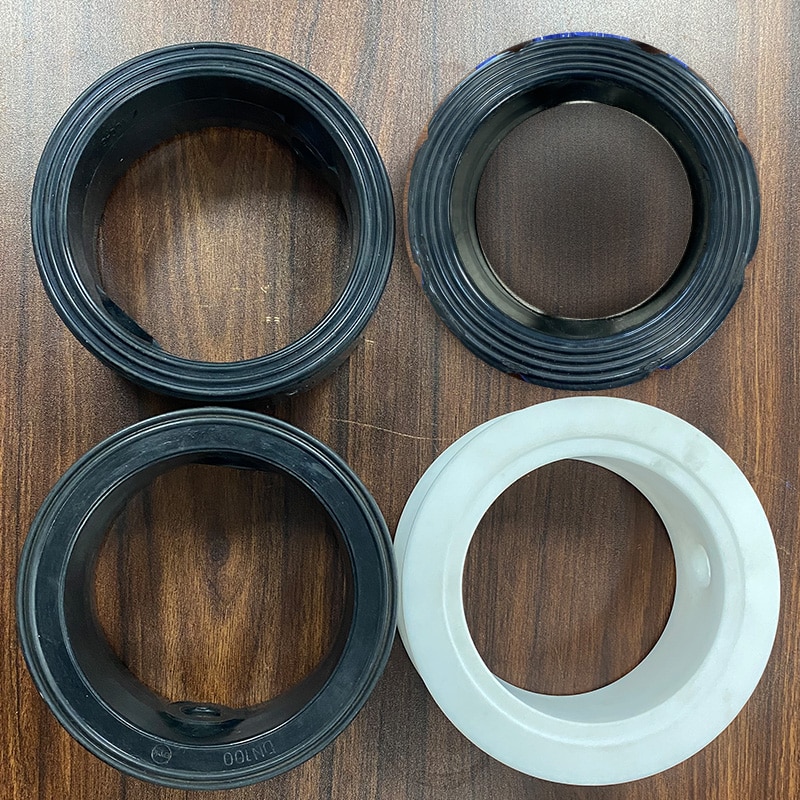
- Seal wear under throttling service: In throttling applications, soft-seated valves are more vulnerable to continuous erosion compared to simple on/off service. Over time, this often results in leakage due to a damaged or ineffective seat seal.
- Unsuitable for high differential pressure: Throttling under significant pressure drops intensifies cavitation and erosion risks. Standard concentric soft-seated butterfly valves are generally not suitable for such demanding conditions.
Butterfly Valve vs Control Valve
Butterfly Valve vs. Control Valve: How to Choose the Right Option for Your System
When evaluating whether a butterfly valve is suitable for flow control, it helps to compare it directly with other commonly used control valves. The table below highlights the key differences:
Characteristic / Valve Type | V-Port Ball Valve | Specialized Control Valve | ||
Primary Function | On/Off + coarse throttling | Precise throttling + shutoff | Throttling + shutoff | High-precision throttling |
Control Accuracy | Moderate to low | High | Moderate to high | Very high |
Cost | Low (especially advantageous in large diameters) | Medium | Medium to high | High |
Flow Resistance / Pressure Drop | Low (when fully open) | High | Moderate | Depends on design |
Typical Applications | Water systems, pumping stations, cooling water | Steam, small-diameter process water | Industrial fluids | Power plants, chemical processes |
Butterfly Valve Practical Application Advice
Based on the analysis above, here are some practical recommendations:
Scenarios where butterfly valves can be confidently used for flow control:
- Large-diameter, medium- to low-pressure water systems where precision is not critical.
- Projects requiring an economical solution.
- Cooling water circulation or systems where coarse flow adjustment is sufficient.
Scenarios where butterfly valves are not suitable for throttling:
- Processes that demand high-precision, highly repeatable flow control.
- Applications involving high differential pressure or cavitation risk.
- Systems requiring stable operation at small openings over long periods.
Options to enhance butterfly valve control performance:
If your application falls somewhere in between, consider double-offset or triple-offset metal-seated butterfly valves. Thanks to their eccentric design, the disc experiences less friction against the seat during operation, offering better control characteristics and longer service life.
At TFW Valve, we provide a range of eccentric butterfly valve solutions engineered specifically to meet these demanding applications.

Conclusion
Butterfly valves can indeed be used for flow control, but their strength lies in cost-effective, large-diameter applications requiring coarse regulation rather than high-precision control. When making a selection, it is important to evaluate the medium, pressure, temperature, accuracy requirements, and budget as a whole.
If you are still considering which valve is best suited for your project, the expert team at TFW Valve is here to help. Our comprehensive product range—from standard concentric butterfly valves to high-performance eccentric designs—ensures reliable and economical solutions tailored to water supply and treatment projects.
Contact us today for free valve selection advice and technical consultation.
FAQ
Can a butterfly valve be used for isolation?
Yes. Butterfly valves are commonly used as isolation valves, especially in water supply and circulation systems. However, the choice depends on the operating conditions:
- For standard medium- and low-pressure service, a soft-seated butterfly valve is generally sufficient.
- For high-temperature or high-pressure applications, a triple-offset metal-seated butterfly valve is recommended.
In critical applications—such as oil, gas, or highly corrosive media—gate valves or ball valves are usually the preferred choice.
Can a butterfly valve be used for throttling?
Yes, but it is more suitable for coarse adjustment rather than precise control. Keep in mind:
- Limited accuracy: Butterfly valves are not designed as dedicated control valves and should not be relied upon for high-precision flow regulation.
- Small-opening risks: Operating at low disc angles can expose the valve to erosion, vibration, water hammer, or cavitation, which may damage the disc and sealing elements.
- Service life impact: Continuous throttling operation accelerates wear and can significantly shorten the valve’s lifespan.