
In the field of industrial fluid control, butterfly valves are widely used for their compact design, quick operation, and low flow resistance. At the heart of their performance lies the rotating “butterfly wing” at the center—the butterfly valve disc. Serving both as the gate that shuts off flow and the vane that regulates it, even the smallest change in disc angle can directly influence the movement of the medium within the pipeline.
However, valves that may look similar on the surface often differ greatly in sealing performance, service life, and operating range. The root cause of these differences lies in the material selection and structural design of the disc. Understanding these characteristics is the key to fully grasping the true performance of a butterfly valve.
Functions and Roles of the Butterfly Valve Disc
To appreciate the importance of disc design, it is essential to first understand its core functions. Driven by the valve stem, the disc rotates 90° within the valve body to achieve shutoff and regulation:
- Shutoff Control: At 0°, the disc presses tightly against the seat to create a reliable seal. At 90°, the disc aligns with the flow direction, resulting in minimal pressure drop.
- Flow Regulation: Between 0° and 90°, the degree of disc opening determines the effective flow area, thereby controlling the volume of fluid passing through.

Common Butterfly Valve Disc Designs and Applications
Not all butterfly valve discs are the same. Their geometry is carefully designed to meet different operating conditions and performance requirements. The most common types include:
- Concentric Disc
Design Features: The disc’s rotation center coincides with the center of the valve seat (a concentric design), with the sealing surface evenly distributed along the edge of the disc.
Applications: Suitable for general shutoff duties where high control precision is not required. Typically paired with soft seals such as rubber or PTFE to ensure tight closure. This is the standard configuration for soft-seated butterfly valves.
- Double-Offset Disc (High-Performance Butterfly Valve)
Design Features: The disc’s rotation axis is offset from both the seat centerline and the pipeline centerline. This design ensures the disc gradually engages or disengages from the seat during operation, reducing friction and wear.
Applications: Enables the use of metal seats for higher pressure and temperature resistance, making it ideal for demanding flow control in medium to high-pressure conditions.
- Triple-Offset Disc
Design Features: Building on the double-offset design, a third offset is introduced—the conical angle of the seat sealing surface. This creates a cam-like, wedge action that achieves a frictionless seal and true zero leakage.
Applications: Widely used in critical industries such as oil & gas, power generation, and chemical processing, where valves must withstand high temperatures, corrosive media, and strict zero-leakage requirements.

Common Materials for Butterfly Valve Discs
The material of a butterfly valve disc directly determines its suitability for different media and operating conditions. Each material varies in terms of strength, corrosion resistance, and cost. Therefore, disc selection must be matched carefully with the characteristics of the fluid, as well as the system’s temperature, pressure, and corrosiveness. The most common disc materials include:
Material Type | Key Features | Typical Applications |
Cost-effective and strong; often coated with epoxy for improved corrosion resistance | Municipal water supply, HVAC systems, clean water, and mild media | |
Carbon Steel (WCB, etc.) | Excellent mechanical strength and pressure resistance | General industrial pipelines, oil transport |
Superior corrosion resistance; 316/316L perform better in chloride-rich environments | Food, pharmaceuticals, chemical processing, marine applications | |
Disc surface coated with PTFE, offering near-universal resistance to acids, alkalis, and solvents; very low friction for smooth operation | Strongly corrosive media, chemical plants, pharmaceutical systems, ultrapure water | |
Duplex / Super Duplex Stainless Steel (2205/2507) | Combines high strength with outstanding resistance to chloride-induced stress corrosion cracking | Seawater desalination, offshore platforms, aggressive chemical environments |
Titanium Alloy | Exceptional corrosion resistance in seawater and chloride-containing media | Marine engineering, seawater treatment, high-end chemical installations |
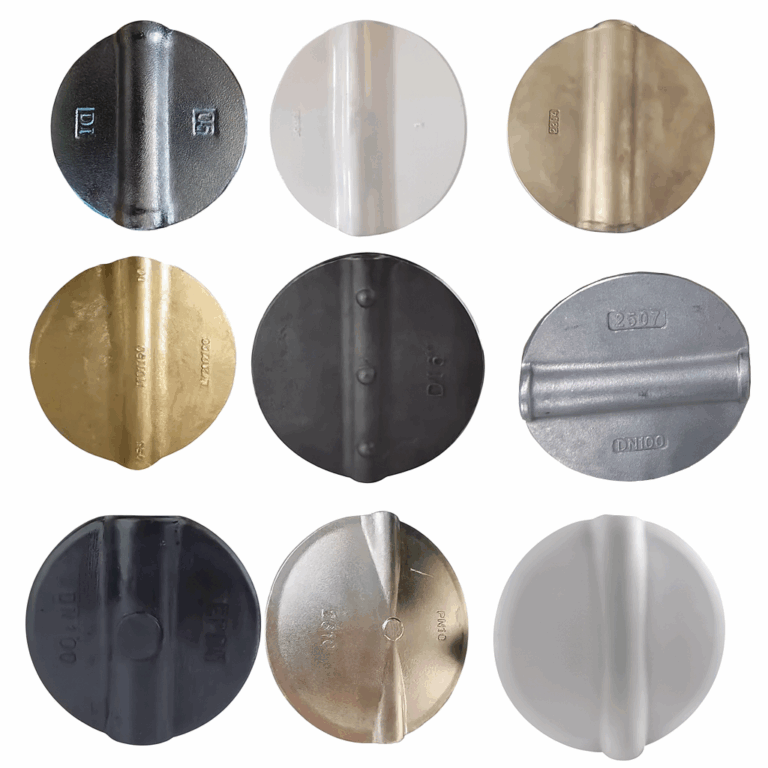
Special Note: Some buyers may wonder why they ordered stainless steel 416, yet the disc is marked as CF8M. The reason is that CF8M corresponds to cast 316 stainless steel under the ASTM A351 standard, which is better suited for direct contact with fluid media. By contrast, 416 stainless steel is a martensitic grade—while it offers high strength, its corrosion resistance is limited, making it more suitable for valve stems rather than valve discs.
For further details, see our article “Stainless Steel Butterfly Valve Material Guide: CF8, CF8M, 304, and 316.”
Key Considerations for Butterfly Valve Disc Selection
When choosing a butterfly valve, the disc design plays a decisive role in overall performance and service life. The following factors should be carefully evaluated:
- Flow Control: Do you require precise flow regulation? The disc profile determines the flow characteristic—whether linear or equal percentage.
- Pressure Loss: Thinner, more streamlined discs reduce resistance when open, helping to minimize energy consumption in pumping systems.
- Cavitation and Erosion: In conditions with high differential pressure across the valve, cavitation and erosion risks increase. Selecting discs with flow-guiding holes or special contours can help mitigate damage.
- Operating Torque: Disc design directly affects the torque required to open or close the valve. High-performance eccentric butterfly valves generally require less torque than concentric types under high pressure, allowing for smaller and more economical actuators.
The butterfly valve disc may appear simple, but it is the core component that determines overall valve performance. By selecting the right disc design and material, you can not only enhance system sealing and reliability but also extend equipment life and reduce operating costs.
If you are looking for high-performance butterfly valve solutions tailored to different operating conditions, we invite you to contact TFW Valve for professional selection advice and technical support.




