
In the selection of valves for piping systems, engineers are often faced with a challenge when faced with butterfly valves of large caliber (DN100 and above) or with a certain operating differential pressure: how to realize manual operation in an economical and reliable way? Directly pulling the huge handle is not only laborious, but also difficult to ensure that the valve stably maintains its position under pressure. This is where the worm gear butterfly valve becomes an attractive solution.
In this article, we will introduce in detail the application scenarios and expanded functions of geared butterfly valves, and analyze the common problems of worm gear butterfly valves and their solutions.
When is it suitable to use worm gear butterfly valve
- Large diameter or medium to high differential pressure conditions
When it is necessary to operate butterfly valves of N100, DN200 or even larger, or when there is a significant differential pressure on both sides of the valve. The worm gear box has a strong deceleration and torque increasing ability, which can make the operator much easier.
- High-frequency operation or maintaining intermediate openings for long periods of time
The worm gear mechanism has a natural self-locking characteristic (based on the friction angle principle). As long as the worm guide angle is properly designed, medium pressure or vibration is usually unable to drive the worm wheel backwards, thus maintaining the butterfly plate in a stable position without the need for additional braking devices.
- Tight installation space
In contrast to handle operation (which requires more space to rotate), the worm gear handwheel can be rotated vertically, making it suitable for tight spaces (e.g. underground wells, pipeline-intensive areas) and can be operated remotely by means of an extension rod.
- For cost-effective manual solutions
Compared to electric, pneumatic or hydraulic actuators, worm gear drives are much simpler in construction and are often far cheaper to purchase than automated actuators, providing better cost-effectiveness.

When is a worm gear butterfly valve not suitable?
- High-frequency operation (e.g., multiple times per hour)
Worm gear and worm gear friction heat and wear will be accelerated, and maintenance costs will increase dramatically, electric/pneumatic actuators should be selected.
- Remote control or automation integration is required.
The worm gear box is a purely manual device and cannot be operated remotely or receive control signals.
- Need to precisely adjust the flow
Manual worm gear operation is not fine enough, suitable for switching or rough adjustment, precise adjustment needs to be equipped with actuators.
- The operating point is difficult to access (e.g., high altitude, hazardous areas)
Personnel can not easily reach the operation, remote implementation of the program should be considered.
In order to meet the more complex or challenging use of the environment, worm gear butterfly valve can be installed according to different needs of a variety of practical accessories, so that the valve with more convenient, safer, more intelligent, the following are several common function expansion program and its typical application scenarios
Expansion of Worm Gear Butterfly Valve and Its Application Scenarios
- Adding Extension Lever
By lengthening the operation lever or extending the operation device, the operation handwheel is accessible from the ground to the butterfly valve in the well or confined space.
Applicable Scenarios:
- Underground valve well room, water plant, city pipeline network
- Narrow or confined space where operation cannot be accessed
Advantages: no need to work down the well, improving safety and convenience.

- With Locking Device
Gearboxes with locking holes or latch structure allow locking with padlock in fully open or fully closed position.
Applicable Scenarios:
Fire protection systems, industrial pipelines, schools, neighborhoods and other places that require high security.
Advantage: Prevent misoperation or unauthorized person from opening the valve, enhance the safety and security of system operation.
- Limit switch
Realize “full open/full close” signal output through mechanical or electrical limiters, and some models support connection to PLC or remote monitoring system.
Applicable Scenarios
Fire fighting linkage system, intelligent water supply, industrial automation, unattended pumping station
Advantages: Realize status monitoring and alarm linkage, suitable for systems with high requirements on safety and control precision.
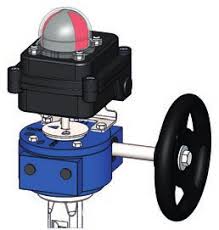
- Enclosed Waterproof Gearboxes
Gearboxes are equipped with IP rating or corrosion-resistant coating, which can effectively waterproof, dustproof and rustproof.
Applicable Scenarios
Outdoor installation, year-round exposure to rain and snow
Advantages: Enhance durability, reduce maintenance frequency, and extend service life.
- With position indicator
Visual indication of “OPEN / CLOSE” at the center of the handwheel or at the top of the box.
Applicable Scenarios
- Piping systems with frequent inspections by operation and guarding personnel
- Engineering sites with centralized installation of multiple valves
Advantages: Easy to quickly identify the status of valves and reduce misoperation.

Although worm gear butterfly valves have a reliable structure and are easy to operate, there are some common failures that can occur during long-term use if they are not properly maintained. Here we will specifically analyze the causes of these problems and provide practical solutions to help you better maintain and use the valve.
Common Problems and Solutions for Worm Gear Operated Butterfly Valves
Problem 1. Difficulty rotating the handwheel, opening and closing
Possible causes:
- Insufficient lubrication inside the gearbox or stalling due to corrosion
- The valve has not been operated for a long time, resulting in fouling of the shafts or sticking of the seals
- Gear ratios are too small for the current torque requirements
Solution
- Check gearbox lubrication, add or replace grease
- Remove the valve to clean and lubricate the operating shaft and sealing surfaces
Problem 2. Handwheel idles but valve does not move
Possible causes:
- Gearbox internal disengagement or connecting key off
- Output shaft or valve stem broken
- Loose screws lead to transmission disengagement
Solution
- Disassemble the gearbox and inspect the linkage for dislodgement or damage
- Replace damaged gear parts or reinstall fasteners
- If the stem is broken, replace the entire valve or actuator assembly
Problem 3: Valve cannot be fully closed or fully opened
Possible causes:
- Limit bolts are set incorrectly
- Foreign matter between valve plate and pipe wall is blocked
- Gearbox is not zeroed, starting angle is shifted
Solution:
- Re-adjust the limit bolts to ensure that the valve is fully open/closed within 90°.
- Clean the pipeline of impurities and check the range of motion of the valve plate.
- Loosen the gearbox to re-center and adjust again.
Problem 4: Valve springs back easily when operated at an intermediate angle
Possible causes:
- Reversing torque due to backlash of the medium during operation
- Gear structure with too little damping or without self-locking function
Solution:
- Replace the worm gearbox with a self-locking function (the worm gear structure itself is self-locking).
- Check that appropriate torque compensation limiters are fitted.
- Install flow stabilizers in the pipelines where adjustment is required.
Problem 5: Gearbox rattles or wobbles badly
Possible causes:
- Poor or loose gear meshing
- Serious gear wear or eccentric installatio
Solution:
- Disassemble and inspect the gear meshing part, adjust the center position or replace the worn parts.
- Add stop screws or support structure to eliminate shaking.
- Regular maintenance, avoid abnormal wear caused by long-term high load operation.
RECOMMENDATION:
- Regular maintenance can prevent more than 90% of problems
- Check gearbox fasteners and lubrication every 6-12 months
- Clean handwheels, drive shafts, and limit screw areas to prevent sediment buildup
- Install protective covers for outdoor equipment or use special corrosion-resistant gear sets
Worm gear butterfly valves are ideal for reliable manual operation due to their good deceleration and torsion increasing ability and natural self-locking characteristics. Through reasonable selection and the combination of extension lever, limit switch, locking device and other functional extensions, worm gear butterfly valves can not only meet the reliability and safety of daily operation, but also further enhance the convenience of maintenance and the overall efficiency of the system in different scenarios.
TFW Valve has been focusing on providing customers with high-performance valve solutions for many years, covering both standard products and customized needs. Whether for seawater desalination, industrial pipeline network or municipal water supply and other complex conditions, we always insist on rigorous engineering design, selected materials and perfect quality management, to provide customers with products that can stand the test.
If you have other questions, please contact us.




